
Maximizing impact by offering free, evidence-based parenting support
Maximizing impact by offering free, evidence-based parenting support
Supperted by


Online programma

Our story
The idea for this project began with a simple but urgent question: how can we improve children’s mental health in a way that is scalable, evidence-based, and impactful? Inspired by professional experiences and concerning societal trends (such as the declining mental health among youngsters, expanding waiting lists and rising youth care costs), we decided to take action.
We started by taking a step back.
Instead of jumping into solution mode, we conducted a literature and market review to verify whether the problem we identified was indeed as urgent and widespread as it seemed. We wanted to ensure that our understanding was grounded in evidence and to learn from existing solutions already in use. Throughout this process, we tried to keep an open mind, acknowledging that improving current interventions or making them more accessible might be more effective than creating something entirely new.
.png)
Research
Needs assessment
Planning
Development
Scale, Neglectedness, Solvability*
1. Half of all mental disorders begin before the age of 14.
They are often preceded by general psychosocial difficulties, which can develop into serious mental health issues. These problems account for 45% of the global disease burden among people aged 0 to 25 *.
Although steps have been taken to improve youth mental health services, many needs remain unmet. At the same time, the cost of youth care continues to rise. This highlights the urgent need for better preventive strategies that can help change the course of mental health problems early on.
2. The parent-child relationship is a key determinant of children's mental health.
Research shows that parental support, a strong emotional bond, and secure attachment significantly enhance children's resilience and cognitive development, while reducing the risk of stress, anxiety, depression, school dropout and juvenile delinquency (sources 1 2 3).
Given the strong connection between children's mental health and the quality of the parent-child relationship, early support for parents is a key opportunity for prevention. We believe that supporting parents in their caregiving role is one of the most cost-effective ways to strengthen children's resilience and reduce the risk of mental health problems.
However, recent needs assessments raise concerns about the
accessibility or attractiveness of the support currently available to parents.

Studies suggest that stigma around youth care services makes it harder for parents to seek help.
Many still view asking for support as taboo, uncommon, or think their questions and concerns are not 'severe' enough. In addition, some parents are unaware of available (reliable) resources, or find them difficult to access due to costs, lack of time, or other practical barriers.
This is concerning, as parental knowledge often does not align with what research shows to be effective or harmful for children*. For example, more than 1 in 4 primary caregivers indicate that physical punishment is necessary to raise and educate children properly*.
The research led us to important insights.

Early intervention works best

Focus on parents can increase impact
.jpeg)
Online delivery increases access
Many mental health issues begin in early childhood, often following general psychosocial difficulties. Addressing problems early can prevent heavier problems later in life.
Instead of one-on-one child support, one intervention can benefit multiple children in a family and help parents handle both current and future challenges.
Online programs are not bound by time or place, making them highly accessible and scalable without extra staffing. Parents appreciate the privacy and flexibility, especially when discussing sensitive topics.
Our goal is to support parents by strengthening their confidence and offering practical parenting strategies - so they feel equipped and free to choose what works best for them and their children.
The Program
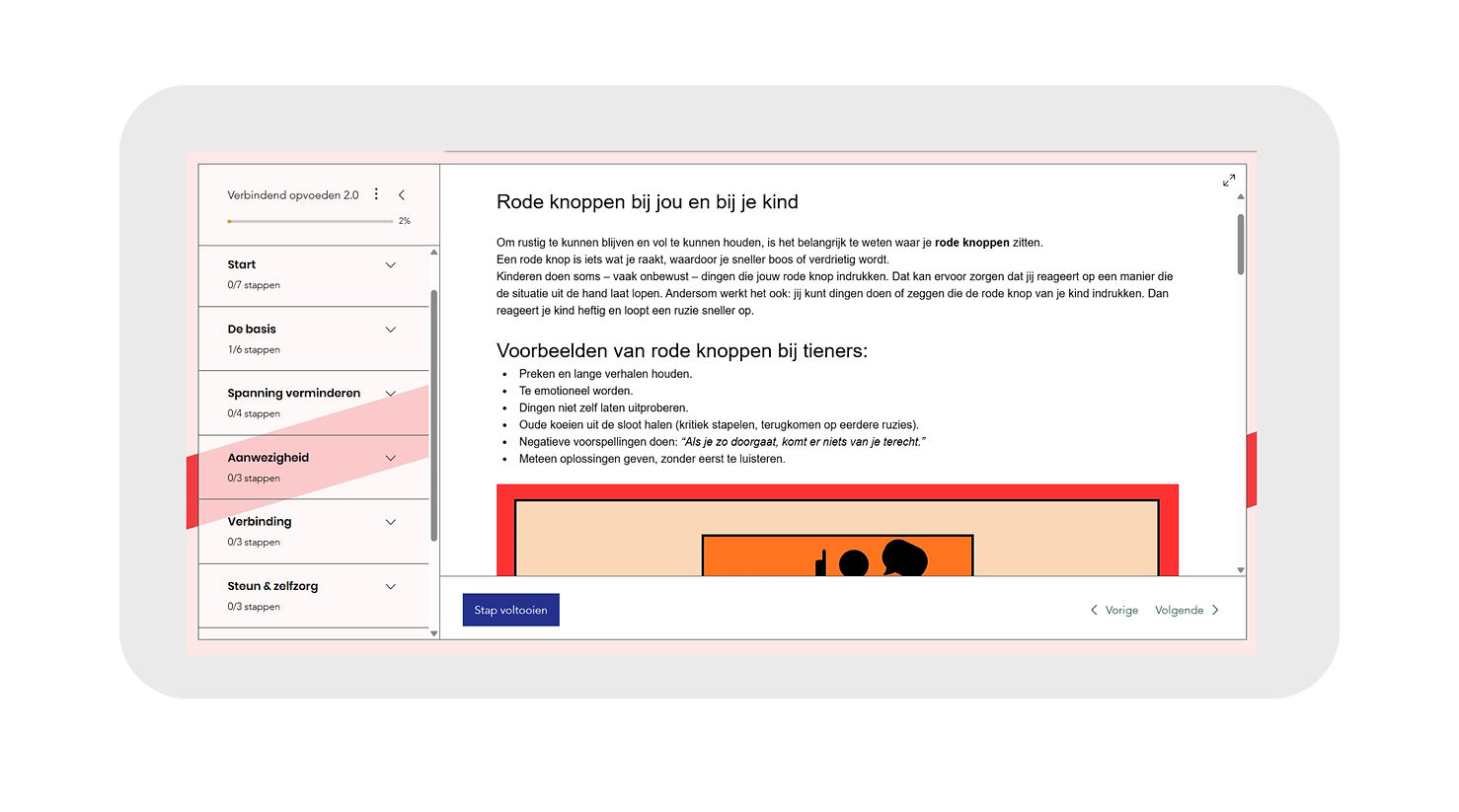
We are developing an online (self-help) program that supports parents in managing challenging behavior and strengthening the bond with their children. In doing so, we aim to reduce parenting stress and improve children’s mental health. The program in a nutshell:
Social support to boost motivation and engagement
Through online and face to face group sessions, parents can connect with one another, share experiences, and find mutual support and recognition.
Reliable and evidence-based
The content is developed by professionals and grounded in scientifically supported parenting strategies.
Flexible and inclusive
The program is free, fully online, and open to all. Parents can participate anytime, anywhere, at their own pace, and for as long or as short as they need.
First results needs assessment

Our Approach
To ensure our program fits real-world needs, we co-create it with both parents and professionals. We combine scientific insights with practical experience, keeping usability and inclusivity in mind.
Our goal is to have measurable, long-term impact. We’re committed to adapting - or even stopping - if the evidence shows it’s necessary. All materials are openly available under a Creative Commons license, so others can join in, share, and help improve them.
We transparently share our reasoning, methods, and outcomes, including what doesn’t work. By doing so, we hope to make it easier for others to learn from, build on, or improve what we’ve started.
Project planning

Phase 1
Literature review and needs assessment
We review scientific literature and existing interventions to identify effective elements and current gaps. At the same time, we explore what parents need and value through surveys and interviews. This phase forms the foundation of a focused and evidence-informed design.
.png)
Phase 2
Co-Iterative Content Development
We co-create the program with parents and professionals through iterative testing and feedback loops. Scientific evidence is combined with practical, real-world experience. This ensures the content is both relevant and effective.
.png)
Phase 3
Pilot Study
We test the first version of the program with small groups of parents.
We observe how they use it, gather feedback, and measure early outcomes. Insights from this phase help us refine and improve the program.
.png)
Phase 4
Cost-effectiveness evaluation
We conduct a broader evaluation to measure the program’s effectiveness. We assess both short- and long-term impact using validated outcome measures. The results guide decisions about broader implementation.
.png)
Phase 5
Scale-up
If effective, we make the program openly available and work on scaling it up. We partner with organizations to embed it into existing systems. We focus on accessibility, cultural adaptability, and long-term sustainability.